

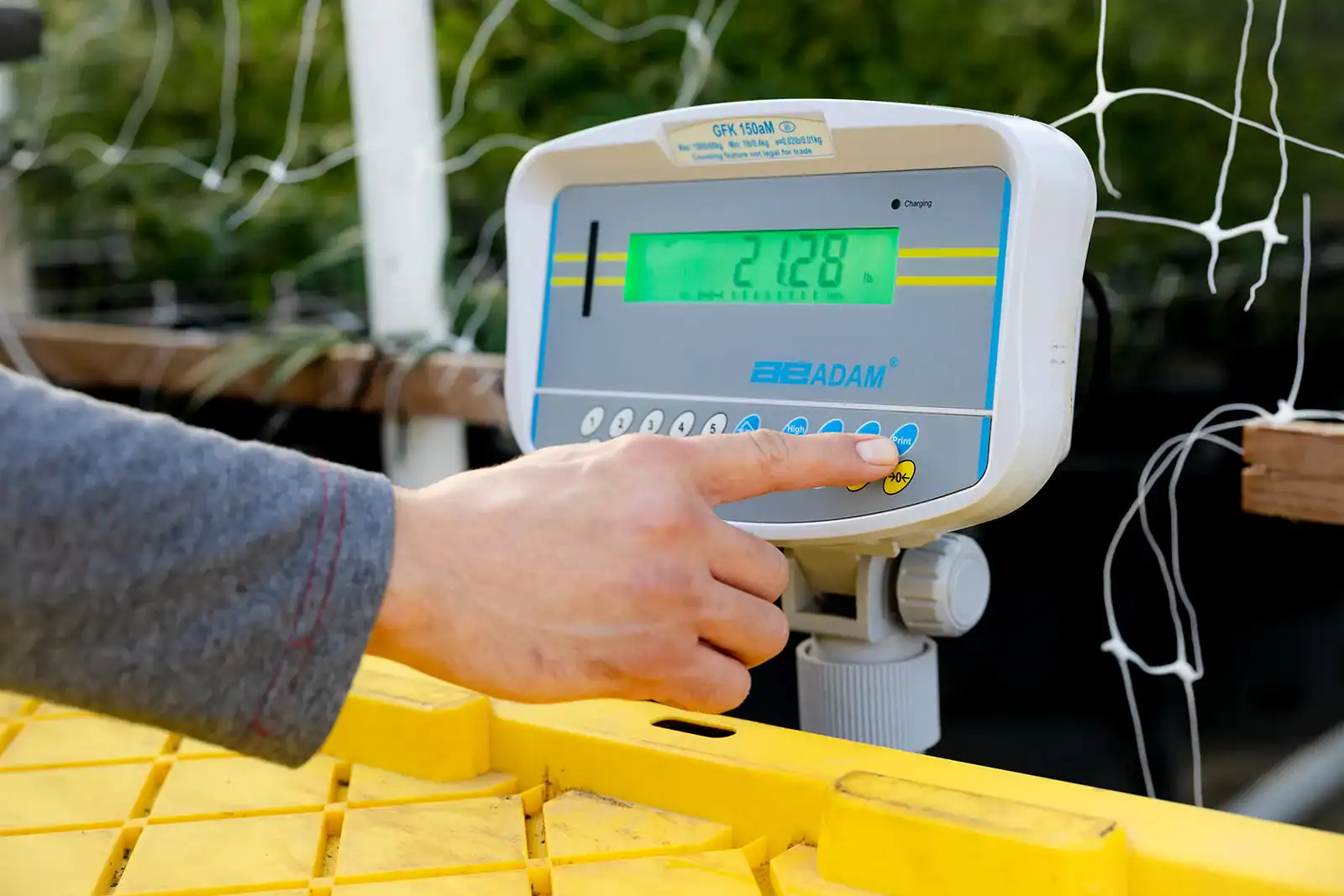
When people see different cannabis scales in the same building behaving differently—one jumping in 10-gram steps, another reading down to fractions of a gram—it’s easy to assume something is wrong. Most of the time, the scales are doing exactly what they were designed to do.
Cannabis scales sit quietly at the center of every operation: harvest weights, tote movements, 3.5 g jars, outbound pallets, and compliance reporting. The real question is whether we’re using the right cannabis scale, with the right configuration, for the right job.
This guide breaks down scale types, components, deck size, indicators, and connectivity in a cannabis facility, and why most operations end up needing at least three distinct setups: one for wet plants and totes, one for packaging, and one for bulk pallets.
In This Guide
The Short Version
Most Operations Need Three Scales
Harvest
High capacity, coarse resolution, a deck sized to the tote.
Packaging
Mid capacity, sub-gram resolution. Where margin is won or lost.
Pallets
Floor platform, 5 ft × 5 ft deck, protective stand.
| Harvest | Packaging | Pallets | |
|---|---|---|---|
| Type | Bench or floor | Bench | Floor platform |
| Typical load | 8,000–12,000 g tote | Tray of jars, small tub | Hundreds to thousands of lb |
| Resolution | 10 g | sub-gram | ½–1 lb |
| Deck | Sized to 28/55-gal totes | Sized to jars | 5 ft × 5 ft |
| Priority | Fast stabilisation | Fill accuracy | Forklift-proofing |
The Two Numbers That Matter on Any Cannabis Scale
When you’re evaluating cannabis scales, two specs matter more than anything else:
- Max capacity – how much weight the scale can safely handle.
- Resolution (division size) – the smallest increment the scale can reliably measure.
Resolution is what people often call “tolerance” or “deviance.” In practice, it answers the question: What’s the smallest weight change this cannabis scale can actually see and display?
Because of how load cells work, you don’t get infinite capacity and infinite precision in one affordable device. For a given price range, higher resolution usually means lower maximum capacity, and vice versa. Instead of fighting that tradeoff, you design your workflow around it.
What’s Inside Cannabis Scales: Deck, Load Cell, Indicator
Every industrial cannabis scale is basically three things:
- Deck – the platform where you place the load.
- Load cell – the heart of the scale. It’s a metal element with strain gauges bonded to it. When you load the deck, the cell flexes slightly; the strain gauges measure that tiny deformation as a change in electrical resistance, which gets converted into a signal proportional to weight.
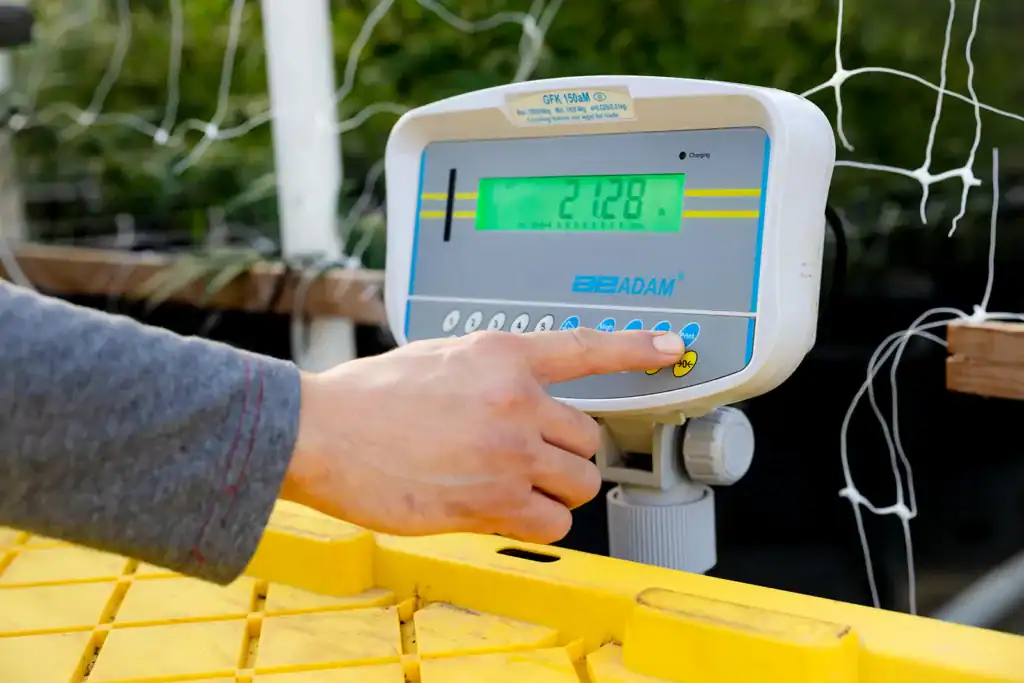
- Indicator – the head unit that shows weight, units, and often handles tare, unit switching, and data output.
Most operators focus on the indicator and the max capacity, but deck size is a big deal for real-world throughput.
Take totes: if you’re weighing something that technically fits the capacity but hangs over the edges of a small deck, the load tends to rock, shift, and take longer to stabilize. That delay doesn’t show up as a line item in your P&L, but it absolutely slows your team down and wastes the value of your cannabis scales.
Harvest: Scales for Wet Plants and Totes
In the harvest area, the priority is throughput.
Wet plants are all over the map:
- Around 1 lb per plant wet for dense indoor rooms with lots of small plants
- Up to 15 lb per plant wet for big outdoor plants that went in early and had time to stretch
If you’re in a state that allows batch weighing, the numbers climb fast. As a rule of thumb:
- About 18 lb of wet cannabis plant fits in a 28-gallon tote
- About 28 lb of wet plant fits in a 55-gallon tote
That 55-gallon tote is physically larger, which is exactly why you don’t want to stick it on a tiny platform. Even if the cannabis scale’s capacity is technically enough, you end up balancing the tote and waiting for the reading to stabilize.
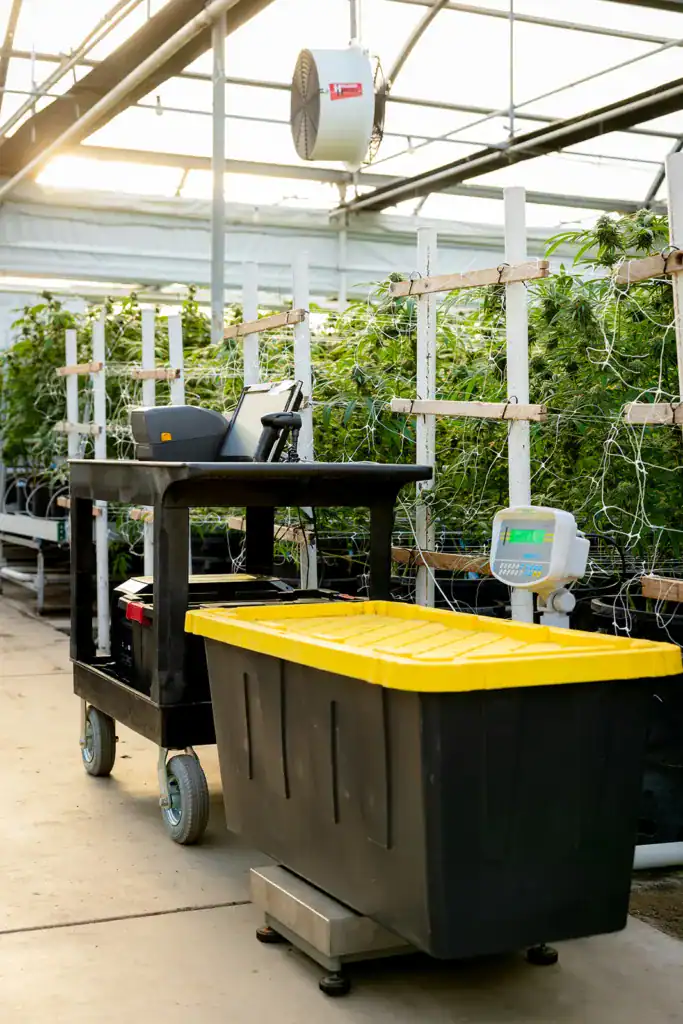
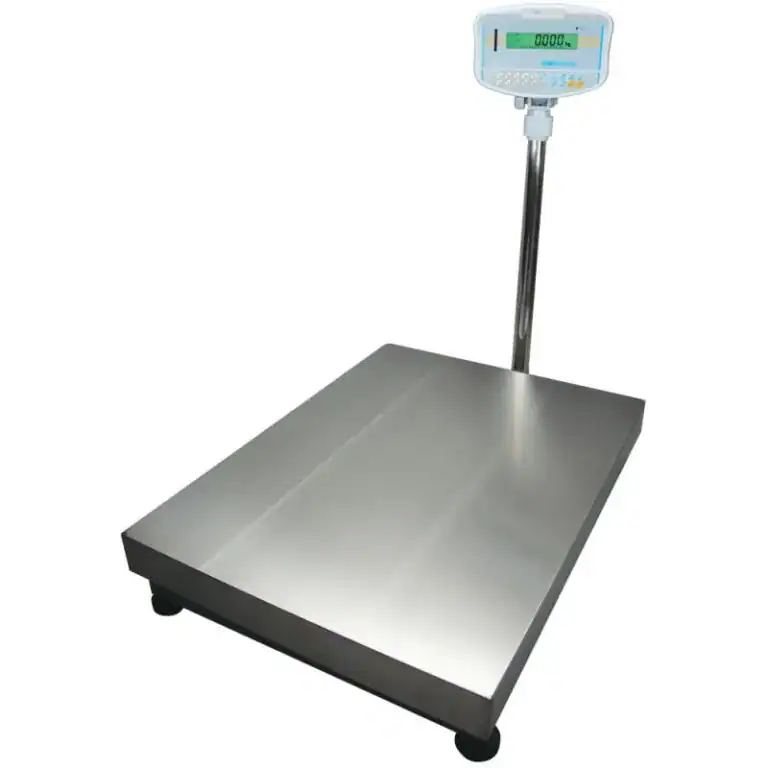
This is where a high-capacity bench or floor cannabis scale with a coarser resolution (e.g., 10 g increments) is ideal. On a tote that weighs 8,000–12,000 grams, being off by 10 g (0.02 lb) is noise. That plant material is going to lose thousands of grams of water in the dry room. What matters here is:
- The scale can safely handle a full tote
- The deck is sized to the container (especially those 55-gallon tubs)
- The reading stabilizes quickly so the crew can move on
For wet weights, capacity, deck size, and stability beat ultra-fine resolution every time.
Packaging: Scales for 3.5 g Jars
Once you move into packaging, the priorities shift completely.
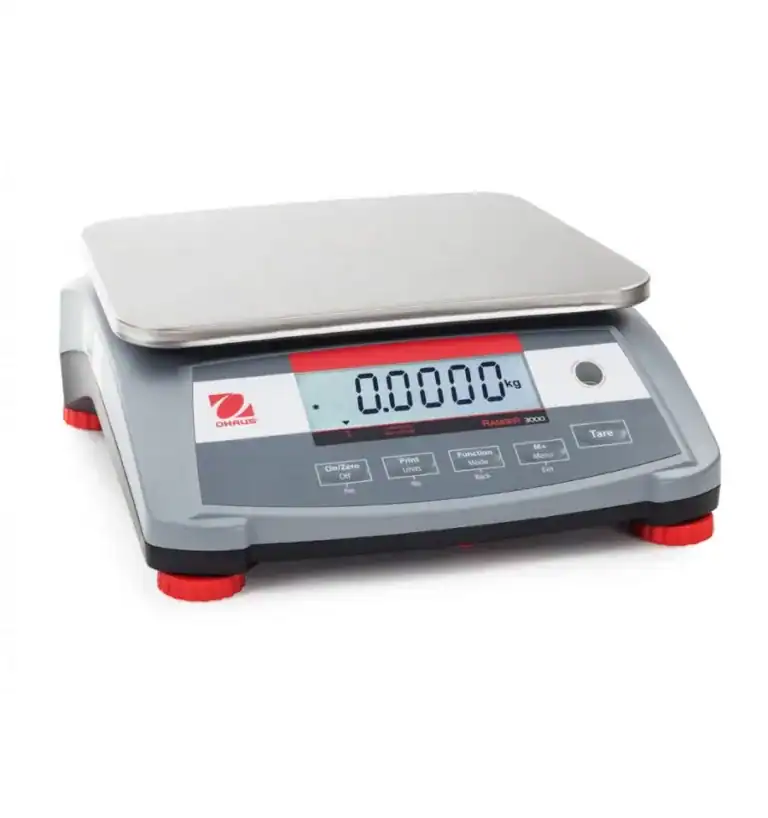
Now you’re filling 3.5 g jars, pre-rolls, or other retail-ready units. At this stage, a 10 g resolution is more than sloppy—it’s expensive. You need:
- Mid-capacity bench cannabis scales (to handle a tray of jars or a small tub of flower)
- High resolution (sub-gram divisions)
Here’s where the math gets real. Take a single pound of flower:
- 1 lb = 454 g
- Target jar weight = 3.5 g
If you’re bang on at 3.5 g, you can fill 129 jars from a pound (454 ÷ 3.5, rounded down), with a couple grams left over as trim or scrap.
Now look at what happens when you drift:
- At 3.7 g per jar, you only get 122 jars from the same pound
- At 4.0 g per jar, you’re down to 113 jars
Assume your pound cost is $500 and each jar sells to a retailer for $16–$18:
| Fill | Jars / lb | Revenue | Profit | vs 3.5 g | Status |
|---|---|---|---|---|---|
| 3.3 g | 137 | $2,192–$2,466 | — | — | Underfill |
| 3.5 g | 129 | $2,064–$2,322 | $1,564–$1,822 | — | On target |
| 3.7 g | 122 | $1,952–$2,196 | $1,452–$1,696 | −7 · −$112–$126 | Overfill |
| 4.0 g | 113 | $1,808–$2,034 | $1,308–$1,534 | −16 · −$256–$288 | Overfill |
Go the other direction and underfill at 3.3 g/jar, and you squeeze 137 jars out of the pound. On paper that looks great—$2,192–$2,466 in revenue—but you’re now shorting customers and setting yourself up for QC, regulatory, and brand trust problems. As Stringer Bell might put it, in this game, if you can’t keep the count right, you’re only playing yourself.
A proper high-resolution cannabis scale in packaging is what keeps you from bleeding margin or underfilling. It also underpins:
- Your inventory and track-and-trace data
- Your ability to defend reported weights in an audit
Deck-wise, you want something sized for jars and small containers. A stable, appropriately sized platform lets packagers work quickly and confidently without fighting wobble or slow stabilization.
Pallets: Deck Size and Forklift Reality
On the outbound side, you graduate to pallet cannabis scales.
These are floor-mounted platforms built to take hundreds or thousands of pounds. Resolution is typically coarser—often ½ lb or 1 lb increments—but the capacity and deck size are what matter:
- You’re weighing full pallets for manifests and invoices, not dosing milligrams.
- Being off by half a pound on a several-hundred-pound pallet is acceptable in most wholesale contexts.
Field Note
One of our customers taught us this the hard way: when you’re weighing pallets, you really want a 5 ft × 5 ft deck. We ran 4 ft × 4 ft decks for two years and spent a ridiculous amount of time trying to land the pallet perfectly on the platform. With 5 ft × 5 ft, the pallet has room to “land ugly” and still be fully supported: drive the jack on, drop, and read.
And then there’s the part few people talk about until it’s too late: forklift damage.
Field Note
Justin and Russ from Central Coast Scales gave us the heads-up that when you buy a pallet scale, you should strongly consider buying the protective stand with it. For roughly an extra 15% of the cost, you get protection against a 100% loss when a forklift driver inevitably clips the indicator or the deck. In a busy warehouse, that’s not paranoia—that’s just planning for the way forklifts actually get driven.
Choosing the Right Indicator for Cannabis Scales: Materials, Screens, and Power
The indicator is the face and brain of your cannabis scales, and small choices here matter over the life of the system.
Materials
- Plastic or painted steel indicators are fine in clean, dry, indoor environments where you’re not washing down equipment or blasting the room with humidity and fertilizers.
- Stainless steel indicators cost more up front, but they’re built for tougher environments: wet areas, frequent cleaning, exposure to sticky kief, dust, and occasional splashes of solvents or cleaning chemicals. They resist corrosion and hold up better when the job site isn’t gentle.
If your indicator is going to live in a trim room with airborne kief and alcohol wipes, or near wet processing equipment, stainless is usually money well spent.
Display type
Environment should drive your choice here:
- LCD indicators are great in climate-controlled indoor spaces. They’re efficient, easy to read in normal lighting, and generally cheaper.
- In hot, bright, or greenhouse-style environments, LCDs can wash out or misbehave as temperatures climb. LED indicators tend to perform better there: brighter, more readable in glare, and easier to see from across the room or yard.
Putting a weak LCD in a hot, bright doorway is a design mistake. Choose the display for where it actually lives, not where the salesperson demoed it.
Power and batteries
Power is another overlooked detail:
- If your cannabis scales will never move and they live in a room with solid wall power, you don’t really need a battery. Plug them in and forget it.
- If your workforce and equipment move around, or you’re relying on less-than-dependable power—generators, solar setups, outlets in the bed of a truck—a scale with a rechargeable battery is a major productivity saver.
Without a battery, every power blip or unplugged cord means everyone stands around waiting for the scale to reboot, reconnect, and restabilize. With a battery, you can:
- Roll a bench scale to where the work is instead of dragging product back and forth
- Ride through generator hiccups without losing work
- Keep harvest or packaging moving when someone trips over a cord
If your operation is even slightly mobile, or your power slightly sketchy, the battery option pays for itself in reduced downtime and fewer frustrated crews.
Indicator Choices at a Glance
| Choice | Pick this | When |
|---|---|---|
| Housing | Plastic or painted steel | Clean, dry indoor rooms |
| Housing | Stainless steel | Wet areas, washdown, kief, solvents |
| Display | LCD | Climate-controlled indoor spaces |
| Display | LED | Hot, bright, greenhouse, doorways |
| Power | Line power | Fixed scales with solid wall power |
| Power | Rechargeable battery | Mobile crews, generators, solar |
| Connection | Bluetooth or Wi-Fi | Clean indoor rooms, low RF noise |
| Connection | RS-232 serial | In the field, RF-heavy buildings |
Connectivity for Cannabis Scales: When Old-School Serial Beats Bluetooth
Modern cannabis scale indicators come with all kinds of connectivity options: Bluetooth, Wi-Fi, USB, Ethernet, and classic RS-232 serial.
- In a clean, indoor setting with limited RF noise, Bluetooth or Wi-Fi can be convenient for streaming weights into PCs, tablets, or label printers.
- Out in the field during harvest, or in buildings packed with radios, metal structures, and wireless chatter, Bluetooth often becomes unreliable or effectively useless.
In those environments, hard-wired serial is still king. That old-school RS-232 cable quietly does exactly what you want: stable, low-bandwidth communication that isn’t fighting for spectrum. When accuracy and reliability matter more than “no wires,” a serial cord from the 80s is still the right answer.
NTEP Classes and Tolerances
Someone is about to pay money for the number on that indicator. That’s why a cannabis scale has to be legal-for-trade—every commodity sold by weight in the US goes across a certified device. If you can’t count on the scale, you can’t count on the weight.
What NTEP Certification Means
The National Conference on Weights and Measures (NCWM) issues an NTEP Certificate of Conformance once a device passes evaluation. The certificate says the device can meet the requirements of NIST Handbook 44, Specifications, Tolerances, and Other Technical Requirements for Weighing and Measuring Devices.
Class II or Class III?
| Class | Resolution | Use it for |
|---|---|---|
| III | 0.1 g and coarser | Wet weight, bulk flower, packaged flower, pallets |
| II | 0.001–0.05 g | Concentrates, small batches of finished goods, unit uniformity checks |
Nobody sells flower in 3.50 g units. They sell 3.5 g. Pre-rolls go out at 1 g or 0.7 g, not 1.00 g or 0.70 g. For flower, the extra decimal place isn’t needed—and every extra weighing is another touch point on the labor bill. Use Class II where it earns its keep: checking individual units for uniformity against your master manufacturing protocol.
Division Size vs. Tolerance
Division size is the scale’s resolution—the smallest step it displays. Tolerance is how far a reading may sit from a reference weight and still pass. An inspector puts a 1.000 lb reference weight on the deck and expects the reading to land within tolerance. How wide that tolerance is depends on the scale’s class and on how many divisions the test load represents.
What the Inspector Checks
- Shift test. The same reference weight, placed at different points on the platform, should give the same reading. If it doesn’t, force isn’t reaching the load cells evenly. Handbook 44 puts a test load of one-third of maximum capacity at four points, each halfway between the center and the front, left, back, and right edges of the platform. On larger scales we adjust each corner sensor; on smaller ones, check the footing.
- Overload. A scale certified to 3 lb should stop showing a weight once more than 3 lb is on the platform.
- Minimum division. If the smallest division is 1 g or 0.5 g, the inspector places exactly that on the pan, checks the reading, then moves it around the pan.
Who Registers Your Scale
Registration happens at the state level, through different offices. California runs its own type evaluation program, CTEP, and pushes enforcement down to county sealers in each county’s agricultural commissioner’s office. New York relies on NTEP, enforced by the NYS Bureau of Weights and Measures.
We’ve been called in to settle disputes that came down to the wrong scale for the job, run at volume. For how METRC reporting mistakes cost margin, see our customer case study.
Private Label Scales
If you’ve noticed that a lot of cannabis scale “brands” look identical, that’s not your imagination. It’s common for one manufacturer to build the hardware and multiple companies to market it under different labels.
The National Conference on Weights and Measures (NCWM), which administers the National Type Evaluation Program (NTEP), even has a dedicated Private Label application for this scenario: when a company markets a device from another manufacturer and re-labels it under its own name.
For operators, the takeaway is simple: focus less on the logo and more on:
- The NTEP Certificate of Conformance and listing
- Capacity, resolution, environmental ratings, and enclosure type
- The quality of local support and service
Putting It All Together (and a Few Shoutouts)
A mature cannabis operation doesn’t treat cannabis scales as random hardware. It treats them as part of process design:
- Harvest and wet handling: high-capacity cannabis scales, decks sized to 28- and 55-gallon totes, coarse resolution, and fast stabilization.
- Packaging and QA: mid-capacity, high-resolution cannabis scales sized to jars, with indicators, materials, and power options chosen for the actual environment.
- Bulk shipments: pallet cannabis scales (ideally 5 ft × 5 ft) with protective stands, forklift-friendly access, and just enough resolution for manifests and logistics.
- Indicators and connectivity: stainless vs painted housings, LCD vs LED, line power vs battery, wireless vs hard-wired—chosen on purpose, not by default.
Along the way, we’ve been lucky to learn from some excellent scale partners. Shoutout to Optima Scales, who have gotten our customers pallet scales lightning fast and taught us a bunch of scale lore we still repeat on job sites. And if you operate in Washington state, Chuck at DBS – Digital Balance Services is absolutely worth your time. He wants you to have the right scale, will happily nerd out with you to dial it in, and was incredibly kind to us when we were getting our feet under us.
We don’t mark up gear or take affiliate fees. We’d rather you end up with the right scales—so if you connect them to METRC Scales later, the hardware is already doing its job.
METRC Scales
Already Have the Right Scale? Connect It.
Our METRC Scales are NTEP certified, run on backup batteries and sync to the cloud, so weights go from the deck to METRC without a pen. No handwritten weights.