
NTEP · Legal for Trade
NTEP Certification, Explained for Cannabis Harvests
What NTEP certification means when you sell by weight, and what our software’s certificate covers.
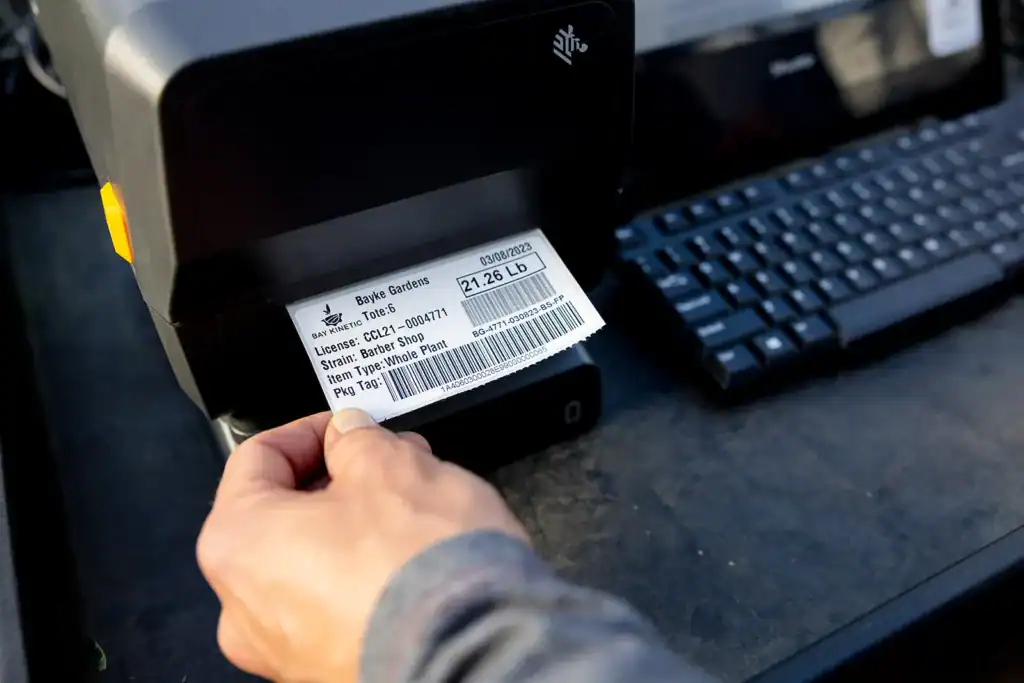
Our software holds NTEP Certificate of Conformance 21-101A1. It works with any NTEP scale or indicator with a serial (RS-232) output, and each label prints the certified gross weight with the plant or package ID, as a scannable barcode.
What NTEP Certification Is
NTEP is the National Type Evaluation Program, run by the National Conference on Weights and Measures (NCWM). A manufacturer submits a device, an NTEP lab tests it against NIST Handbook 44 and NCWM Publication 14, and a device type that passes gets a Certificate of Conformance (CC). The CC says the design meets the national requirements for commercial weighing. It certifies the type, not the individual unit on your floor: each scale still gets inspected, tested and sealed locally. NTEP certificates are accepted in every state.
What “Legal for Trade” Means When You Sell by Weight
A scale is legal for trade when it’s a type-approved device that a weights and measures official has inspected, tested and sealed. In California, DCC regulation §17221 says when cannabis needs one: an approved, tested, sealed and county-registered device whenever cannabis is bought or sold by weight or count, packaged for sale by weight or count, or weighed or counted for entry into METRC. That last trigger is the one that catches farms. A harvest weight goes into METRC, so the scale that produced it has to be legal for trade, even if nothing is being sold that day. Your buyer, your distributor and an inspector all rely on the same number.
Scale, Indicator, Software: What Each Certificate Covers
A harvest weigh-in has several links in the chain, and each can carry its own certificate: the load receiving element (the platform or base the bin sits on), the indicator (the box that turns the load cell’s signal into a displayed weight) and the software that takes the weight from the indicator and records or prints it. The scale maker’s certificate covers the base and the indicator. It doesn’t cover software that sits after the indicator and prints the weight on a label. That software needs its own evaluation, which is what our Certificate of Conformance 21-101A1 is. It covers our point-of-sale software (model “Farm Scale”), not scale hardware: the certificate is for the software, and it works with any NTEP-approved scale.
Our Certificate: 21-101A1
| Certificate of Conformance | 21-101A1, issued 24 Sep 2026, supersedes 21-101 “without lapse” |
|---|---|
| Submitted by | Kapono Design, LLC (Bay Kinetic), Santa Barbara, CA |
| For / model | “Point-of-Sale System Software” / Farm Scale, software version 1.0 or higher |
| Evaluated with | Ohaus TD52P indicator (CC 18-065), Ohaus D125RTX base (CC 18-077), Zebra ZD421 printer |
| Criteria | Handbook 44 (2020), NCWM Publication 14 (2021) |
| Certificate | Certificate 21-101A1 (PDF on ncwm.com) |
Which Scales Work With It
Our software works with any NTEP scale or indicator with a serial (RS-232) output: Ohaus, Adam Equipment, Optima and others.
Each label prints the certified gross weight with the plant or package ID, as a scannable barcode.
How to Check a Scale’s NTEP Certificate
- Read the data plate on the base and on the indicator: the manufacturer, the model and, if shown, the NTEP CC number.
- Search the NCWM certificate database at ncwm.com/ntep-certificates by CC number, or by manufacturer and model.
- Match the details: the certificate lists your model, and your scale’s capacity, division size and accuracy class fall within it.
- In California, check CTEP too. With no NTEP certificate, look for a CTEP Certificate of Approval on the CDFA Division of Measurement Standards site; a type-approved device has one or the other.
- Check the seal and the registration. Your county weights and measures office inspects, tests and seals the scale, and most counties require annual registration.
FAQ
NTEP Questions
Do I need an NTEP scale for harvest weights in California?
Yes, you need a legal-for-trade scale. Harvest weights go into METRC, and DCC rules require an approved, tested and sealed device, registered with your county, for any weight entered into track and trace. It doesn’t have to carry an NTEP certificate specifically: California accepts either an NTEP Certificate of Conformance or a California Type Evaluation Program (CTEP) Certificate of Approval (CDFA, DMS Notice D-18-02). Either way, it must be legal for trade. Other states have their own weights-and-measures rules; check with your state regulator.
Is Class III required?
No. California’s Division of Measurement Standards recommends an Accuracy Class II scale whenever possible, and says a Class III scale may be the best fit outdoors or wherever airflow and vibration affect the weighing, which describes most harvest weigh-ins. The county official confirms at inspection that the scale suits your use (DMS Notice D-20-01).